snow-cuad
A working proof of concept: the CUAD contract corpus loaded into Snowflake, with a lawyer-facing search UI, role-based access, and an access audit log.
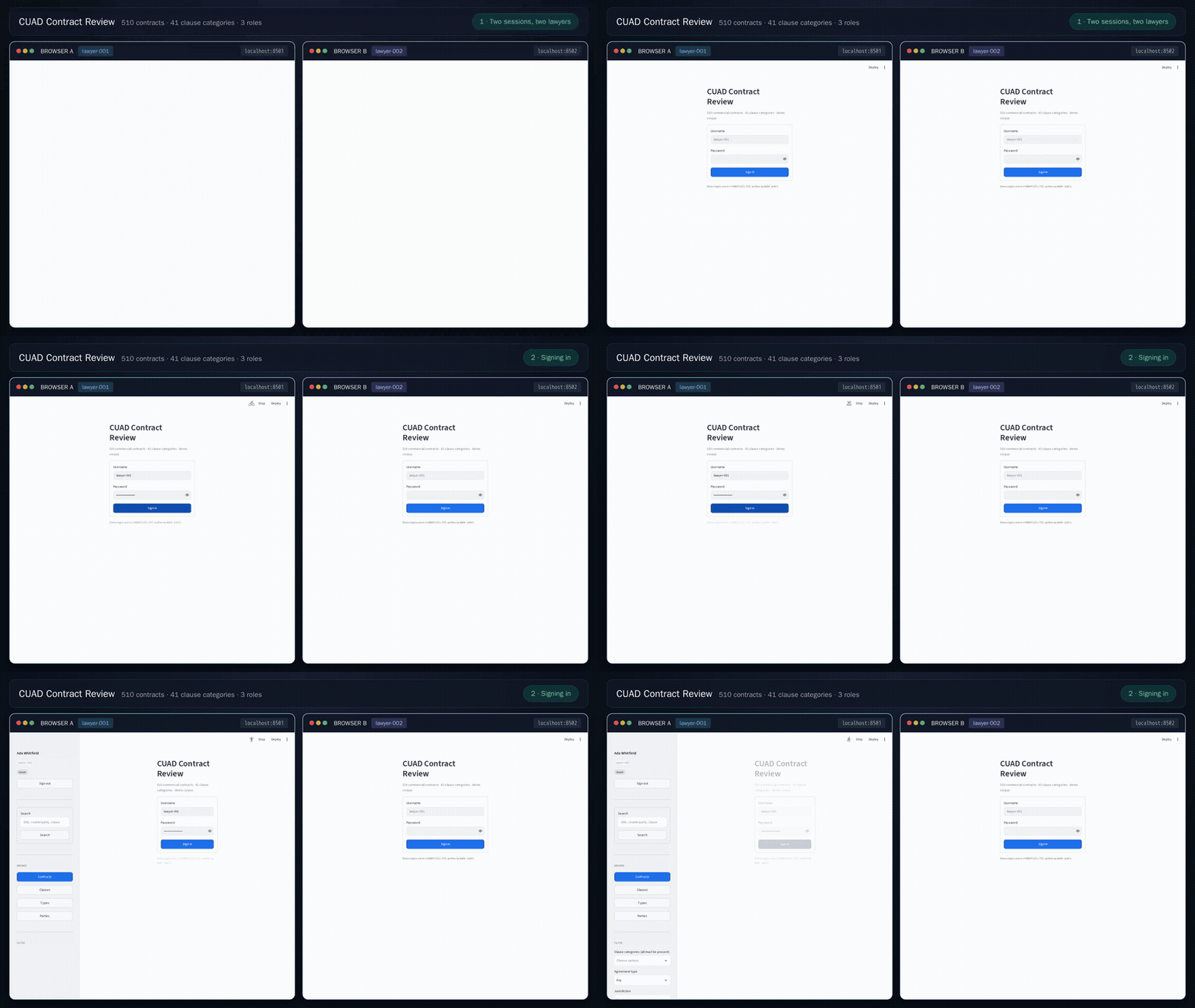
Full walkthrough — 1280×720
What this is
CUAD (Contract Understanding Atticus Dataset) is 510 commercial contracts annotated by lawyers with 41 types of clause that matter during M&A diligence — governing law, change of control, non-compete, IP assignment, and so on.
This project loads that corpus into Snowflake and puts an application on top of it:
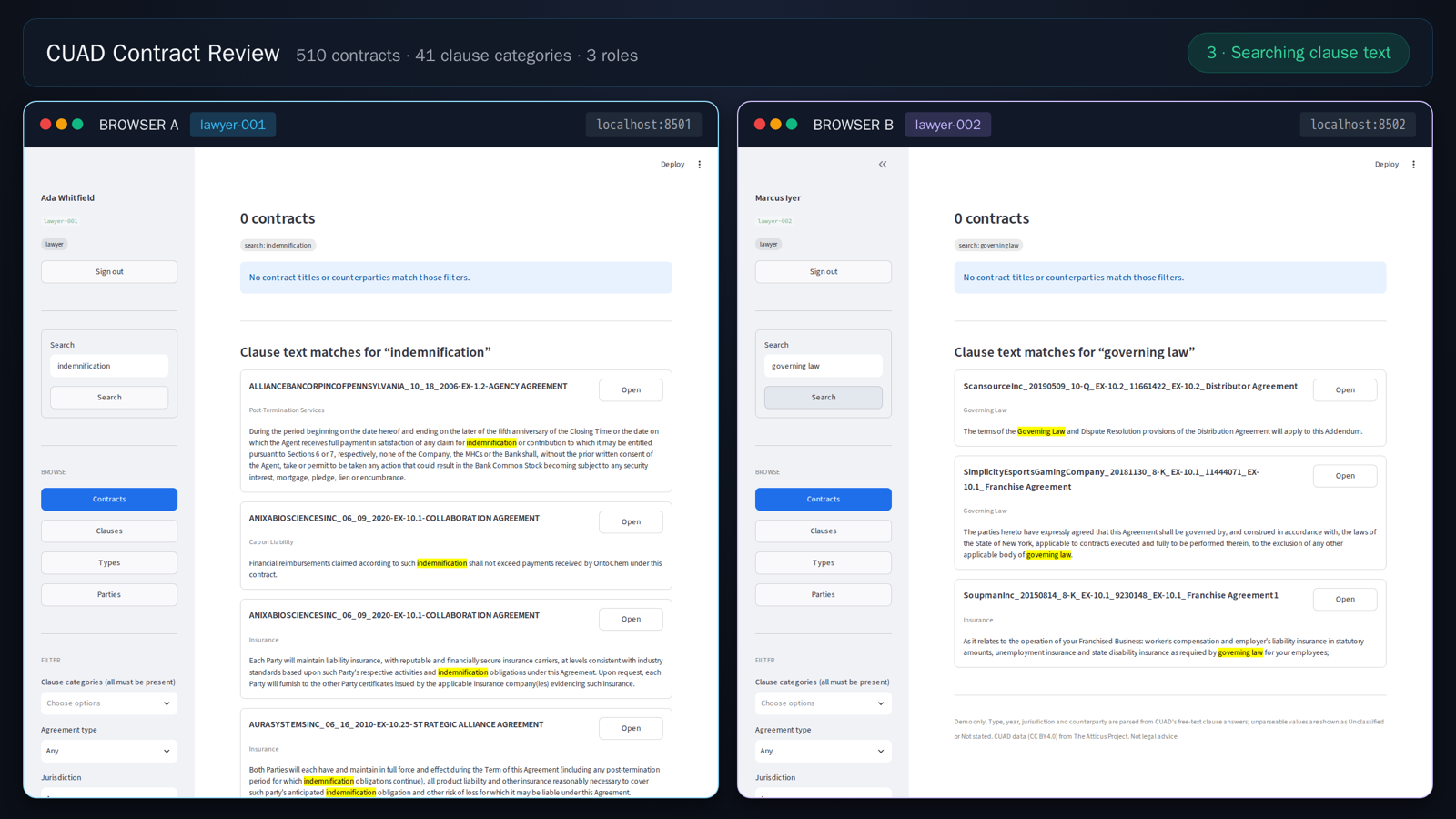
- Search clause text and read the matched clause in its surrounding context
- Browse by clause category, agreement type, jurisdiction, counterparty or year
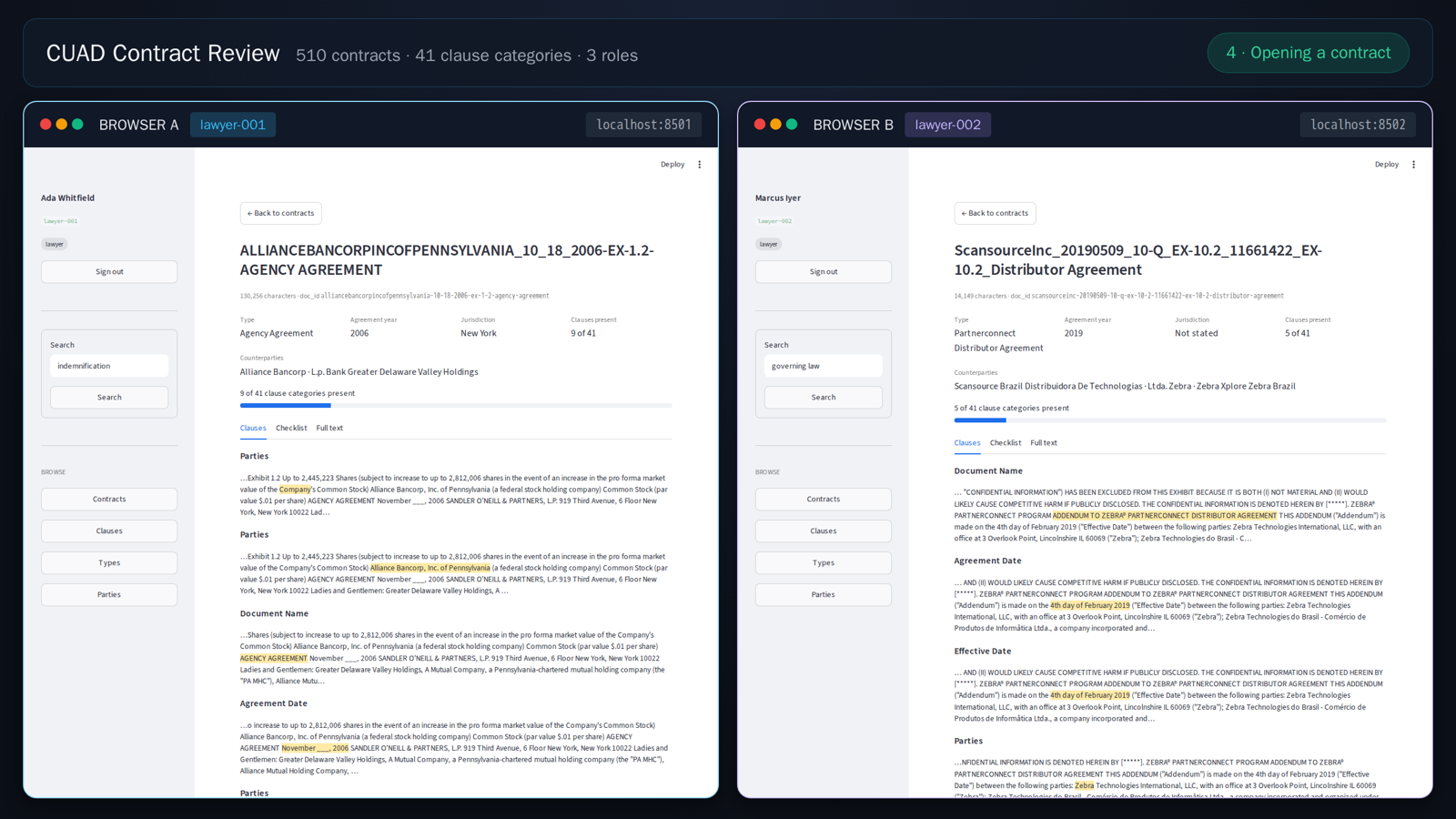
- Related contracts, scored by shared counterparty, clause overlap and type
- Three roles — lawyer, auditor, admin — with an admin console and an append-only access audit log
- Least privilege: the app runs as a dedicated service identity, never as
ACCOUNTADMIN
Everything is reproducible from a single make pipeline.
What this is not
A starting point, not a finished application — deliberately simple:
- No semantic search. Substring matching and structured filters only.
- No document-level access control. Roles decide which pages you get, not which contracts. Every lawyer sees the whole corpus.
- No PDFs. CUAD ships text, not documents.
- Single tenant. No clients, matters or per-matter isolation.
- The counterparty dimension is noisy. CUAD’s party field is free text that mixes entity names with role labels, so only 29 names repeat. See architecture.
Screenshots
Searching clause text, with hits highlighted in the clause and the matched span in amber:
A contract, its 41 annotated clauses, and the related contracts panel:
The admin console:
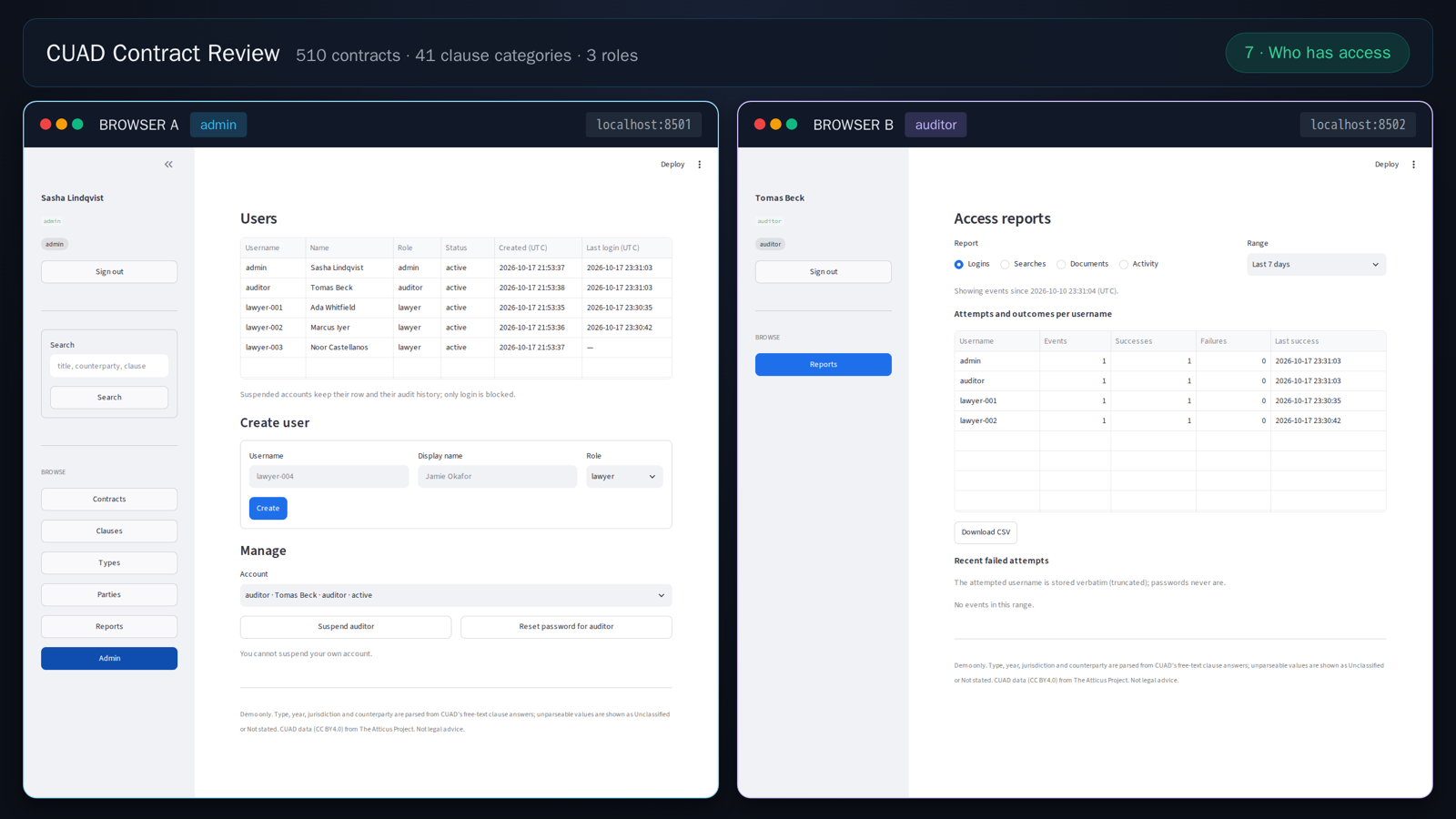
The auditor’s report, narrating the search activity above:
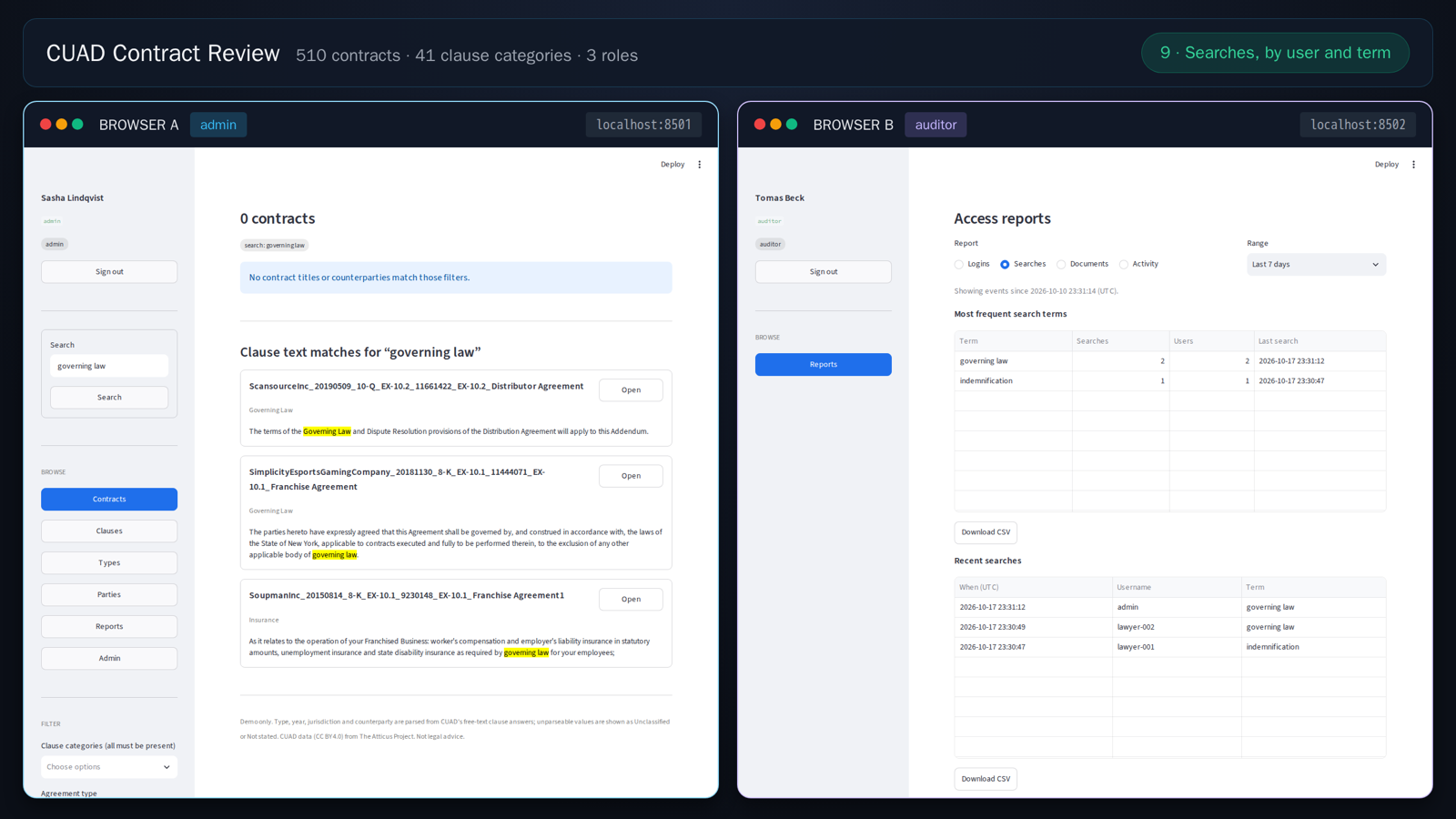
More stills, one per beat of the video, are in
docs/assets/.
Quickstart
Needs Python 3.14, Docker (only for the demo video), and a Snowflake account.
This creates real objects in your Snowflake account — a database, a warehouse, a role and a service user — and spends credits while it runs. It is small (an XS warehouse with 60-second auto-suspend), but it is your account.
make bootstrap     # venv, dependencies, .env from .env.example
$EDITOR .env       # account identifier, login, password
make doctor        # prove the connection works
make pipeline      # corpus + service identity + logins + verification
make app           # http://localhost:8501
make pipeline prints a summary as it goes and ends with all checks passed.
Log in with any of the five accounts in credentials.txt, which it writes
alongside (lawyer-001 … lawyer-003, admin, auditor).
To tear it all down again:
make teardown # drops the database, warehouse, service user and role
Full playbook, including what survives a teardown and the two-step rebuild: docs/operations.md.
What you get
| Table | Rows | |
|---|---|---|
CONTRACTS |
510 | title, length |
CONTRACT_TEXT |
510 | the full contract, for whole-document search |
CLAUSES |
13,823 | one row per annotated clause span, with character offsets |
CLAUSE_CATEGORIES |
41 | the annotation taxonomy |
CONTRACT_DIM |
510 | parsed type, year, jurisdiction, clause count |
CONTRACT_PARTY |
915 | parsed counterparties |
RELATED_DOC |
2,430 | top-5 related contracts per contract, with reasons |
APP_USERS / ACCESS_LOG |
— | app logins; append-only audit trail |
Plus nine views over the above. The interesting part is that CUAD has no
metadata columns — parties, dates and governing law exist only as free-text
clause answers, so everything in the derived tables is parsed, and unparseable
values stay visible as Unclassified / Not stated rather than becoming nulls.
Parse rates and the reasoning are in
docs/architecture.md.
Authentication is three layers, which is worth understanding before changing anything:
| Layer | Identity | What it can do |
|---|---|---|
| 1 | your ACCOUNTADMIN login |
onboarding only — make, DDL, grants, teardown |
| 2 | STREAMLITWEB (service user + role) |
read the corpus, append audit rows, manage app users |
| 3 | the five logins in APP_USERS |
sign in to the app; all share layer 2’s one session |
docs/security.md explains why, and how it is verified.
Layout
Makefile              every task; `make help` lists them
sql/                  00 setup … 08 grants, 99 teardown
scripts/              download, build, load, verify, key and user provisioning
app/                  the Streamlit application
demo/                 builds the demo video (Playwright, in Docker)
docs/                 detail and design notes
.env.example          the only env file that is committed
Docs
| architecture.md | data model, derived dimensions, parse rates, related-document scoring, UI navigation |
| security.md | the three auth layers, the grants, key-pair auth, privilege verification, trust boundary |
| operations.md | the playbook — every make target, teardown and rebuild, troubleshooting |
| demo-video.md | how the demo video is built, and why it needs no compositing |
| build-notes.md | the sharp edges — Snowflake and Streamlit behaviour that cost time |
Attribution and licence
Code is MIT. The CUAD dataset is by The Atticus Project and licensed CC BY 4.0; the contracts themselves are public SEC filings.
Clause spans are expert human annotations, not model output. This is a demonstration, not legal advice.